

Mon 20 July 2026
Property News | Jávea Property Prices Are Up 40%. Here’s What the Notary Data Actually Shows
The notaries don't lie. Unlike asking prices, every figure here comes from an actual completed sale registered with a Spanish notary, straight from the Portal Estadístico del Notariado. We pulled six months of rolling 12-month reports plus the official price series to answer the question everyone in Jávea is asking: is this still a booming market, or is it settling down?
A note on the figures below: each 12-month period overlaps the next by 11 months, since these are rolling totals, not six separate years. Small period-to-period moves can reflect one strong or weak month dropping in or out, so every trend chart here uses an honest, zero-based scale rather than a zoomed-in one that would make small shifts look dramatic.
The headline number: prices are up over 40%, but they've stopped climbing
Early 2025 was the floor. Prices per square metre bottomed out at 2,540 €/m² in Q1 2025, then rose to 3,673 €/m² by early 2026, a genuine increase of around 45%.
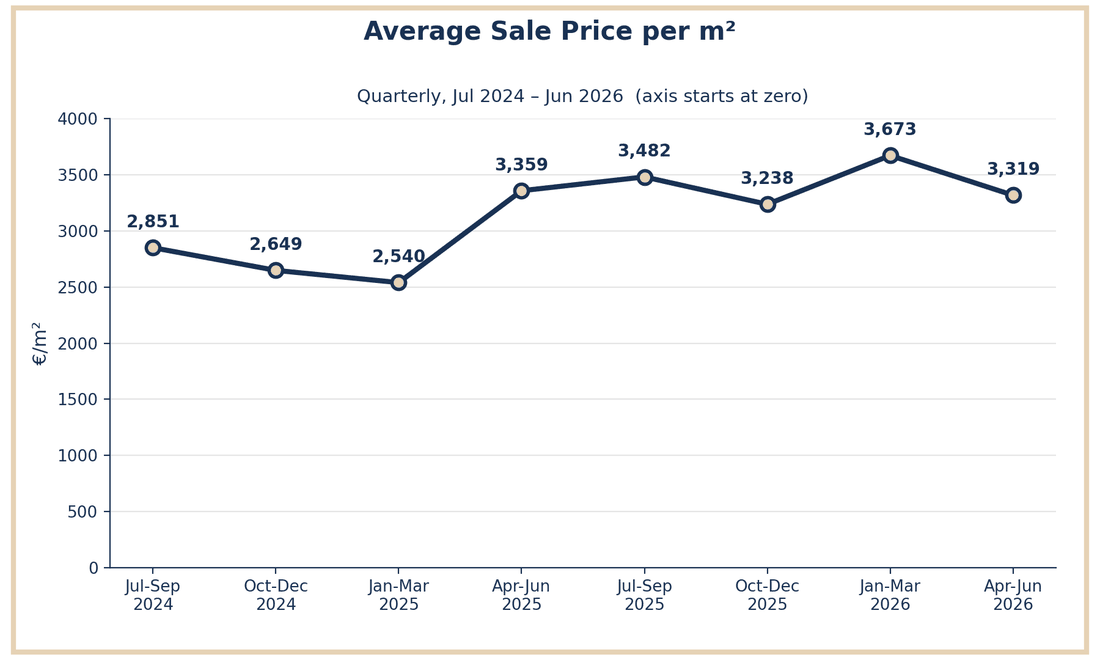
Since mid-2025, prices have been moving between roughly 3,200 and 3,700 €/m² rather than continuing to climb. That looks like a market settling at a new, higher level rather than one still overheating or about to correct. The most recent quarter is also likely still provisional: notary registrations lag the actual sale by weeks or months, so the Apr–Jun 2026 figure will probably firm up as more transactions register.
One outlier worth calling out: June 2025 alone hit 4,679 €/m² on the monthly series, well above every other month on record, which otherwise sat between roughly 2,850 and 3,950 €/m². With relatively low monthly sales volumes, a couple of high-value deals can pull a single month's average sharply upward. We'd treat that month as noise, not a trend.
Sales volumes: a winter dip, then back to roughly where it started
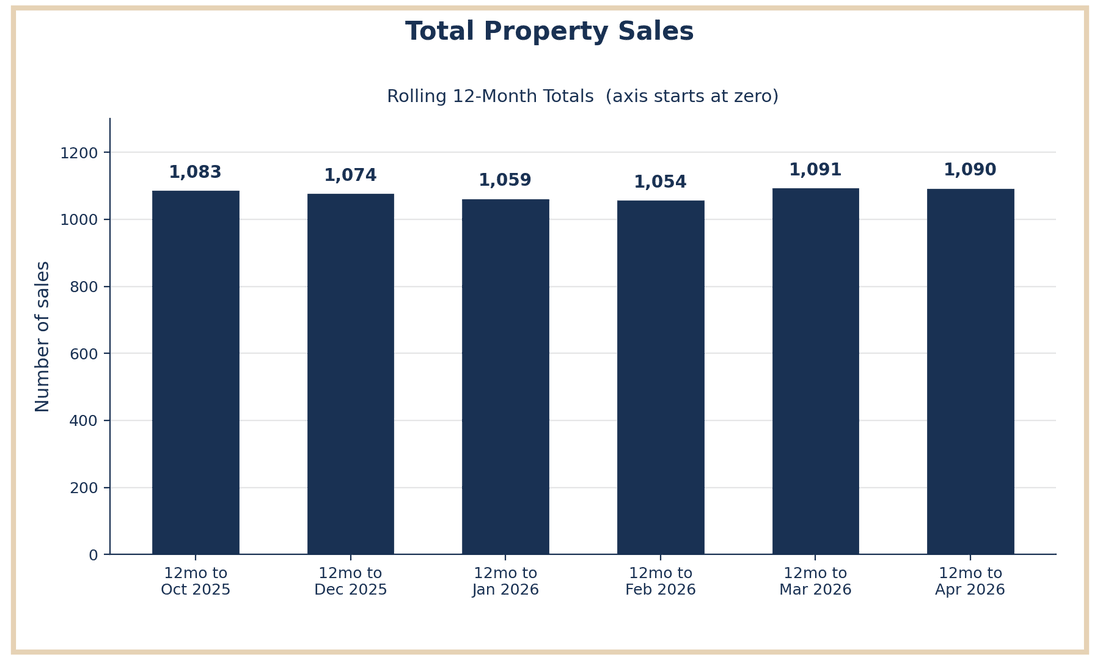
Annual sales eased gently through the winter, from 1,083 to a low of 1,054 in the year to February 2026, then recovered to around 1,090 once March and April 2026 were included. On a zero-based scale it's clear this is a genuinely small move, roughly 3% peak to trough, not a meaningful slowdown or surge. Looking inside the monthly charts, July is consistently the busiest month of the year and August the quietest, a seasonal pattern that has held for well over a year.
Foreign buyers: a modest rise, not a takeover
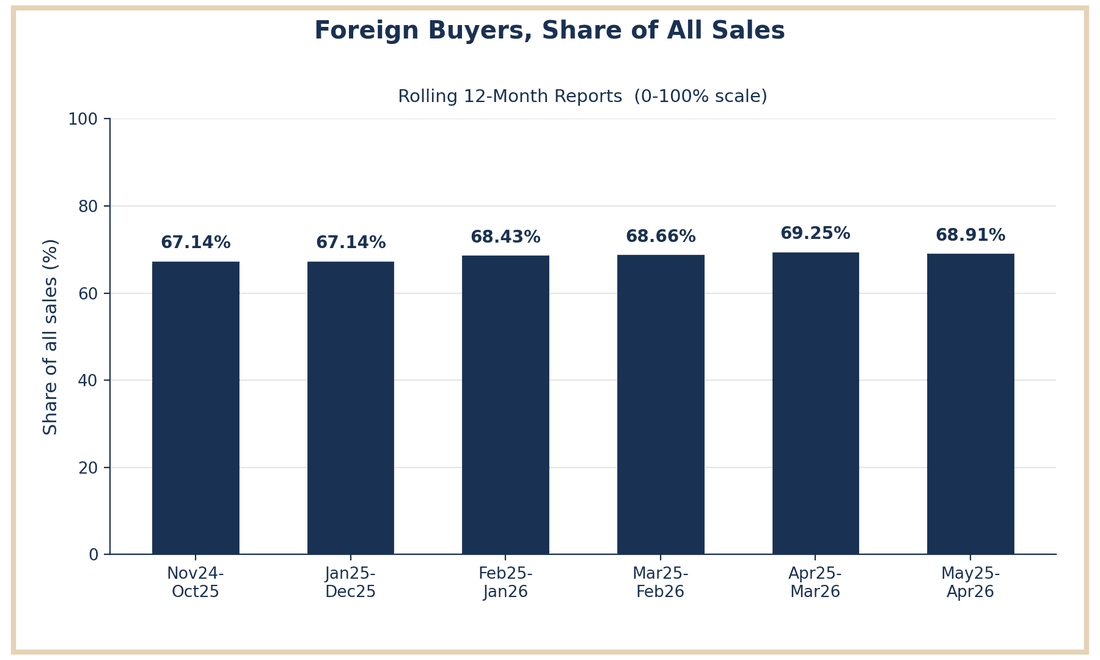
International buyers made up between 67% and 69% of all sales across every report, a narrow band. It has drifted upward slightly rather than climbed sharply.
Here's the nationality breakdown behind that figure, from the most recent 12-month report:
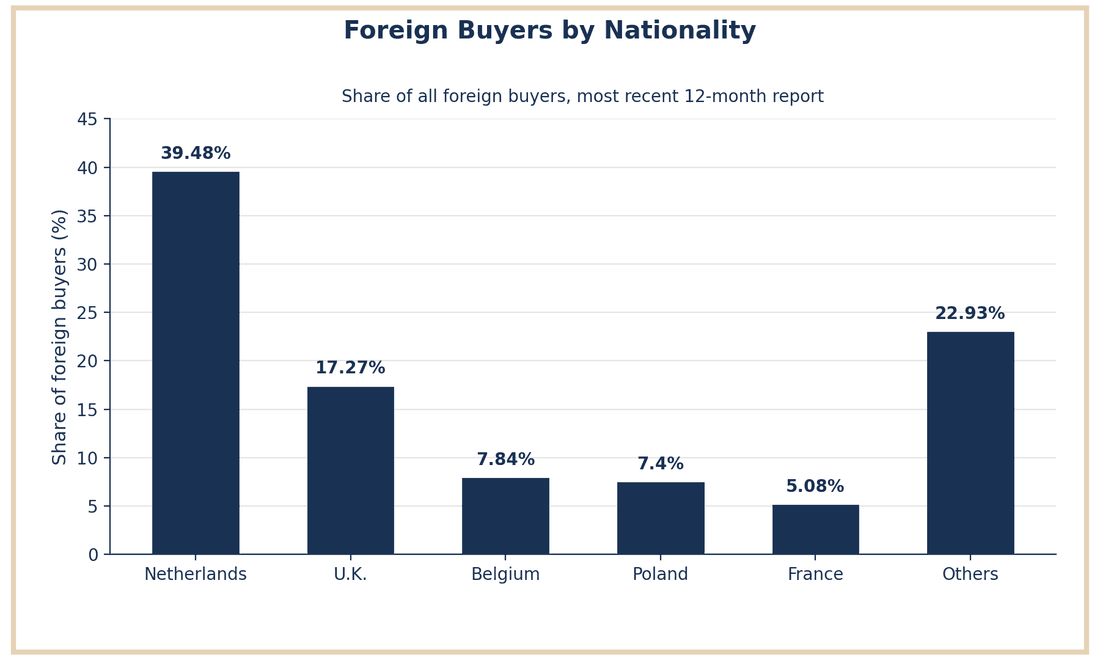
Snapshot from the most recent report (May 2025 to April 2026), based on figures published by the Portal Estadístico del Notariado.
Within that foreign buyer group, the Dutch remain the largest single nationality by far, holding steady between roughly 39% and 41% of foreign buyers throughout. The chart below looks at the UK specifically. Note this is the UK's share of foreign buyers only, a different and smaller base than the "share of all sales" chart above, so the two aren't directly comparable on the same scale.
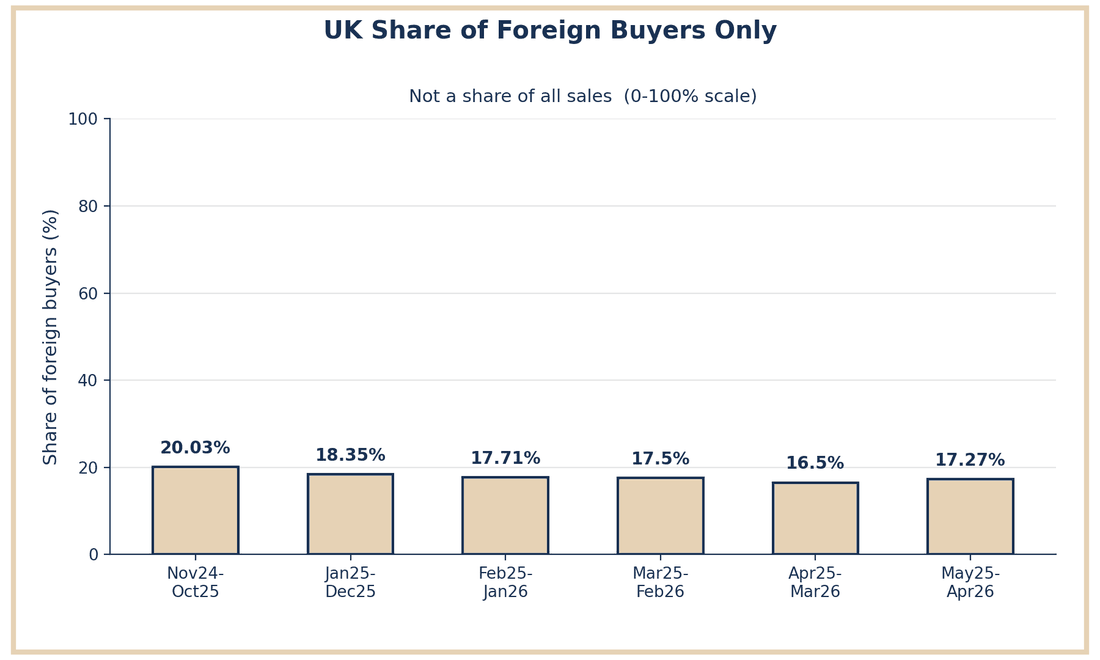
The UK's share of foreign buyers has slipped from around 20% to around 17%, with the most recent report showing a small recovery from a low of 16.5%. That's a real decline, but it's a shift within a fairly narrow band, not a collapse. Belgium has stayed steady around 7 to 8% of foreign buyers, and Poland has moved between roughly 5.5% and 7.75%. France appeared among the top nationality groupings in the two most recent reports where Germany previously did; with both sitting in the 5 to 6% range, this is a small shift worth watching rather than a firm trend yet.
Median buyer age has held close to 53 throughout (54 in the earliest report only), and apartments continue to outsell houses by roughly 57% to 43%, a split that has barely moved.
New builds: a real increase, though a modest one
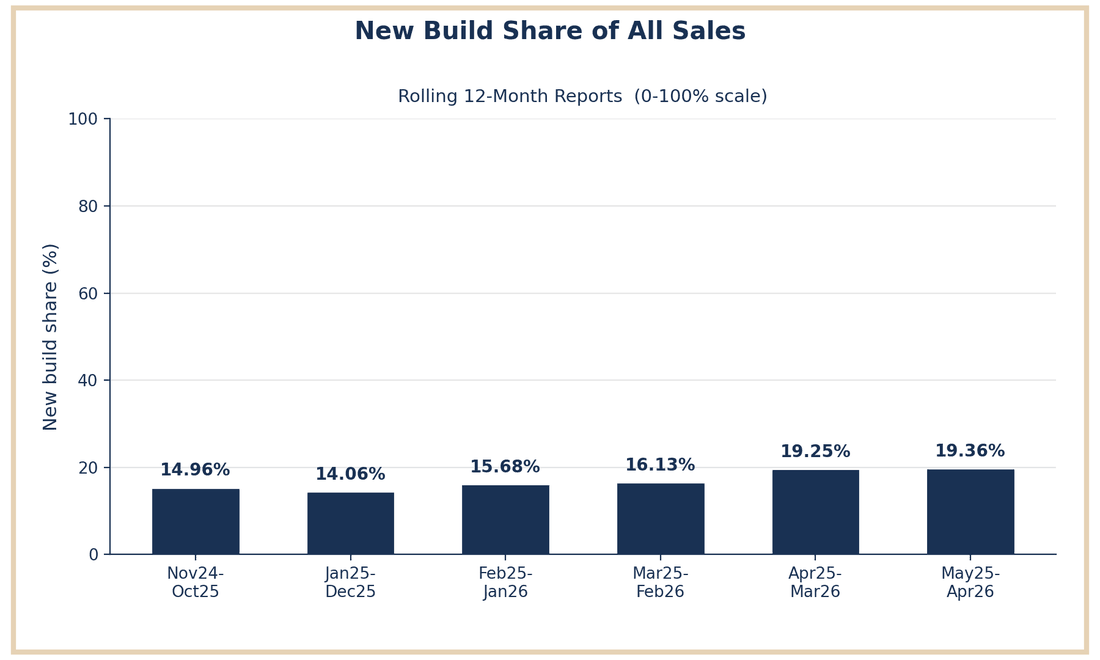
New build sales rose from 14.96% of the market a year ago to 19.36% in the most recent report, an increase of about 4.4 percentage points, or roughly 29% in relative terms. That's a genuine increase and worth noting, but it's not a doubling, and second-hand homes still make up around four out of every five sales. It lines up with more new developments in Jávea reaching completion and notary stage over the past year.
So, is it stabilising?
On balance, yes, at a higher level than a year ago. The sharp price rise seen from early to mid-2025 has not continued: since then, prices have moved within a 3,200 to 3,700 €/m² band rather than climbing further, and annual sales volumes are essentially flat, within about 3% of where they started. The shifts in buyer nationality and property type are real but modest, a few percentage points here and there, not dramatic swings. Prices aren't falling and buyers haven't disappeared, but the picture is one of a market holding steady rather than one still accelerating.
If you've been waiting for a dip to buy in Jávea, the data suggests this plateau, not a future correction, may be as good as it gets. But as always, treat any single period's figures as one data point in a longer story rather than a verdict on their own.
Source: Portal Estadístico del Notariado (Consejo General del Notariado), municipality of Xàbia/Jávea.