
Tue 4 August 2026
Spain News | A Once in a Century Solar Eclipse Is Coming to Spain
On the evening of Wednesday 12th August 2026, people across Spain will look to the sky for one of the most eagerly awaited astronomical events of our lifetime.
For the first time in more than a century, a total solar eclipse will be visible from the Iberian Peninsula. As the Moon moves between the Earth and the Sun, daylight will fade and parts of Spain will experience a brief period of darkness shortly before sunset.
Taking place at the height of summer, the eclipse is expected to attract residents, visitors and astronomy enthusiasts to viewing points across the country. Here on the Costa Blanca, it promises to be an unforgettable addition to an August evening in Jávea.
Why Is the 2026 Eclipse So Special?
Although partial solar eclipses can occasionally be seen from Spain, a total eclipse is much rarer. During totality, the Moon completely covers the bright surface of the Sun, briefly revealing its outer atmosphere, known as the corona.
The path of totality on 12th August will cross Spain from west to east. It will enter the peninsula through Galicia before travelling across northern and eastern areas of the country, including Asturias, Castilla y León, the Basque Country, Navarra, Aragón, Catalonia and the Valencian Community. It will then continue towards the Balearic Islands.
The eclipse will take place late in the day, with the Sun already low on the western horizon. This should create a particularly striking scene as the light changes during the final part of the evening.
What Will We See in Jávea?
Jávea is located just outside the narrow path of totality. This means we will not experience complete darkness, but the view should still be spectacular. More than 99% of the Sun is expected to be covered at the height of the eclipse, creating an extremely deep partial eclipse.
The eclipse is expected to begin at approximately 19:39 and reach its maximum at around 20:34. As it approaches its peak, the daylight should become noticeably dimmer and take on an unusual, pale appearance.
Because the Sun will be very low in the sky, the best viewing place will not necessarily be one of Jávea’s familiar sea facing viewpoints. A clear and unobstructed view towards the west or west northwest will be essential. Buildings, trees and mountains could hide the Sun during the most dramatic part of the eclipse, so it is worth choosing your location in advance.
We have prepared a complete local guide with expected timings, viewing advice and important solar glasses instructions. Read everything you need to know about watching the solar eclipse in Jávea here.
Watching the Eclipse Safely
However impressive the eclipse may be, eye safety must come first. Looking directly at the Sun without suitable protection can cause serious and permanent damage to your eyesight, even when almost all of it is hidden by the Moon.
As the eclipse will remain partial in Jávea, there will be no point at which it is safe to look directly at the Sun without protection. Proper solar eclipse glasses that meet the ISO 12312-2 safety standard must be worn throughout. Normal sunglasses, smoked glass and homemade filters are not safe substitutes.
Cameras, binoculars and telescopes also require specialist solar filters fitted to the front of the equipment. Children should be supervised closely and shown how to use their eclipse glasses correctly before the event begins.
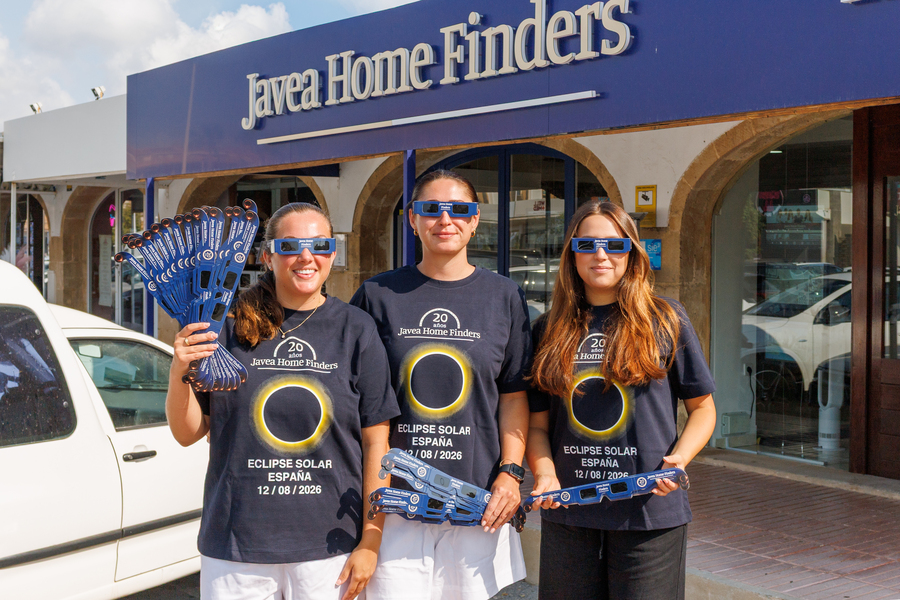
Javea Home Finders is giving away free solar eclipse glasses from our office to help our local community enjoy the occasion safely. You can pop in between 08:00 and 14:00 to collect yours and read the full usage instructions before the big day.
An Unforgettable Summer Evening in Jávea
The eclipse is likely to bring people together at viewpoints, terraces and open spaces throughout the Marina Alta. Whether you live in Jávea permanently, own a holiday home here or are visiting for the summer, it is a rare opportunity to share an extraordinary moment with family, friends and neighbours.
Popular viewing areas, roads and car parks may be busy, so plan ahead and arrive early. Take some water, protect yourself from the summer heat and check that your chosen spot has a genuinely clear view of the western horizon.
Once the eclipse has finished and night falls, the evening could offer another reason to keep watching the sky. The date coincides with the peak of the Perseid meteor shower, one of the best known meteor showers of the year.
With a dramatic eclipse at sunset followed by shooting stars after dark, 12th August 2026 could become one of the most memorable summer evenings Spain has seen in generations.
Do not forget to collect your free glasses, read our solar eclipse guide and safety instructions and tag Javea Home Finders in your photos on the night. We would love to see where you watched it from.